Pontassieve 2008: Pontassieve in Tuscany, Italy


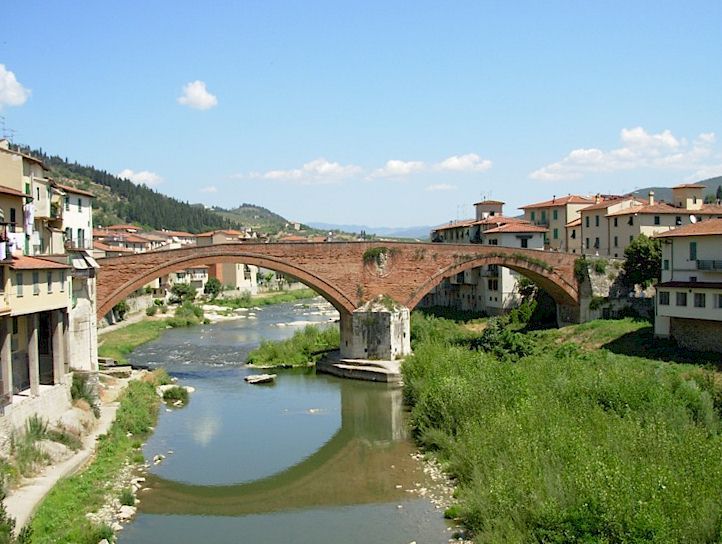
The bridge at Pontassieve

Pontassieve is a town of about 20,000 inhabitants located 14 km east of Florence in Tuscany at the confluence of the Arno and Sieve rivers. It was heavily bombed during the the war because it was an important railway junction. However, new construction and restoration make it still a pleasant place for a brief visit when visitng the Casentino area from Florence.


Bed & Breakfast Pontasieve

Bed & Breakfast rooms with pool - air conditioned (at Molino del Piano near Pontassieve)

Agriturismo Podere Castelfidardo offers stylish and comfortable Bed & Breakfast double rooms (en suite bathroom) in a beautiful farmhouse with a large swimming pool, located 15 km from central Florence. We are also accessible by frequent and fast trains from Florence (20 minutes). An ideal location for visitors who want to visit the sights of Fiesole, the Casentino and Chianti as well as Florence. More about Podere Castelfidardo.

History of Pontassieve

The first rulers of the territory now known as Pontassieve were nobles of the Quona family, whose Lordship is documented from the 11 C. The Quona, a branch of whom also appeared under the name Filicaia at a later date, abandoned country life and migrated to Florence at the end of the 12 C, selling, in 1207, a large part of their lands to the Bishopric of Florence.

The village of Pontassieve first developed under Florentine dominion. In 1375, Florence ordered the construction of a castle of strategic importance and the village became known as Castel Sant’Angelo. Pontassieve took its current name because of the importance of the bridge across the river, controlling access from Florence to the territories of the Mugello, Casentino and the city of Arezzo.

The first houses of the village were built around the bridge below the Florentine castle but there was little growth during Florentine times. However, at the end of the 18 C century, when the Dukes of Lorraine took power, reclamation projects and the opening of two new roads that joined Pontassieve to the Casentino and Emilia Romagna greatly increased economic growth at Pontassieve.

Under the Dukes of Lorraine, Pontassieve became so important that it was elevated to the rank of a Bishopric comprising part of the territories belonging to the valleys of the Arno and Sieve rivers.

In 1859, the building of a railway that joined Florence to Rome gave an additional impulse to the local economy. The construction of this important railway and later the contruction of the Florence-Borgo San Lorenzo railway allowed the town to develop as a modest industrial hub.

In 1861 Pontassieve was annexed to the Kingdom of Italy by the King Vittorio Emanuele II of Savoy.

Pontassieve suffered substantial damage during WW II because of its importance as a rail junction. The railways and the town itself were repeatedly bombed by Allied planes so the town as it now is results, for the most part, from post war reconstruction, although the town has retained its original mediaeval look in the centre.

Main sights in and near Pontassieve

At Pontassieve the old town centre represents all that remains of the Castello di San Michele Arcangelo al Ponte a Sieve. Three gates of the former fortified wall (Florentine, 14 C) are still visible: to the east is the Porta dell'Orologio, to the south is the Porta di Filicaia and to the west the Porta Fiorentina. The Palazzo Sansoni-Trombetta, now the Town Hall, is situated in the centre of the former castle. The Porta dell'Orologio opens onto the original commercial street of Pontassieve, connecting the Castle to the monumental 16 C Medici Bridge over the River Sieve.

After leaving Pontassieve and passing along the river Sieve, the road rises to the Villa della Pievecchia with its mediaeval tower. Further along this road is Podere Villa Grignano and on the right is Poggio di Vico, at one time the seat of a castle of the same name. The road rises again to the Monterifrassine Pass. On the ridge, there is a deviation leading to Montefiesole, the location of the Romanesque Pieve di San Lorenzo and, at the top of the hill, the remains of the castle. During the 12 C, this was the feudal seat of the Florentine Archbishop. A short distance before the Pieve there is a crossroads from which a footpath leads to Villa Tassinaia and the peak of Bardellone, where there is a tabernacle. From the Monterifrassine Pass, looking downhill to Sieci, it is possible to discern a downhill path to the small church of Santa Maria a Novoli. The road continues past Podere Villa Bossi to the turnoff to Pontassieve.

On the right, on the descent towards Sieci, is Villa Poggio a Remole, a 17 C house constructed by the Albizi family around a mediaeval core. Further downhill to the left, towards Pontassieve, is the road leading to the Chiesa di San Martino and then to the spur where the Castello di Quona once stood (destroyed by the Florentines in 1143).

Another interesting route is to follow the road along the River Sieve.
The mediaeval della Torre residence is visible above the road past the slopes of Poggio a Vico. At Mulino di Ponte a Vico, there is a foot route to the remains of a bridge, possibly of Roman origin, which was used until the 15 C. On the road again, there is Podere Casellino and then Montebonello. Uphill towards Acone is the tall Torre di Montebonello (11 C). At Acone, there is a 16 C Pieve. After Acone, the route goes downhill again into the valley of Argomenna and across the road leading to the Villa di Petroio (built by Olivetan monks between the 16 C and 17 C). Further along this road is Santa Maria in Acone and a descent to the bridge of Montebonello. Shortly before the bridge, on the right, there is a deviation to the small churches of San Piero a Sieve and San Martino a Farneto. Returning towards the Podere Casellino farm on the right, it is possible to take the road uphill to Villa di Vetrice (an enlarged mediaeval tower).

Monterifrassine lies further along this road, and from there it is possible to reach the tower-houses of Tigliano. From Tigliano to the left is Doccia, and to the right the road climbs to Galiga. The second road to the rightleads Podere La Sturaia and shortly afterwards to Montalto, with the abandoned church of S. Bartolomeo on the left.
Montalto, one of many castles in Tuscany with this name, has been surrounded by the rural buildings that now occupy the site of the ancient castle. There is the church dedicated to San Lorenzo at Galiga.

To visit the most northerly part of the municipality of Pontassieve, follow the highway SS 67, go through Rufina and Scopeti until the road on the left leading to Colognole. Along this road, the Villa di Colognole is on the left, then the church of Sant'Ellero with the Podere Palagio opposite. After the village of Vicoferaldi, the road becomes a dirt track leading to the Pieve di Scopeto.
Near the Casa del Tamburino, there is a path that leads to the peak of Monte Giovi and to the Monument to the Resistance, from which there is a steep path to the ancient Chapel of San Giusto.


Churches of Pontassieve


Chiesa di Sant'Eustachio ad Acone, also known as Sant'Eustachio in Jerusalem, used to be the mother church of the vast Acone parish.

Chiesa di Santa Maria ad Acone dates to 925 and among its protectors were the Donati family and the San Matteo Hospital in Florence.

Chiesa di Sant'Andrea a Doccia was mentioned for the first time in 1024 in a document, now in the Vatican, by Bishop Hildebrand. It is referred to as belonging to the monastery of San Miniato al Monte.

Pieve di San Giovanni a Rèmole dates from 955 and was head of a parish extending on both sides of the Arno river.

Pieve dei Santi Gervasio e Martino a Lobaco is an 11 C church dedicated to San Gervasio and located in Alpiniano.

Santuario della Madonna delle Grazie is also know as "Madonna del Sasso" because of a series of apparitions of the Virgin Mary that occurred in 1484. The church was constructed in 1490, replacing a mediaeval oratory.

Chiesa di San Martino a Molin del Piano was first documented in the 13 C and was under the patronage of the bishop of Fiesole and the Saltarelli family.

Pieve di San Lorenzo a Montefiesole has existed since 1190 but was transformed into parish church in 1461. It is situated next to the ruins of the castle belonging to the Bishop of Florence.

Prepositura di San Michele Arcangelo was known as the Church of Sant'Angelo a Sieve until the 17 C when it took the name of San Michele. It was first documened at the beginning of the 13 C. It was completely rebuilt in the 18 C and was re-consecrated in 1788.

Chiesa dei Santi Martino e Giusto a Quona was originally dedicated to San Martino but was later called San Giusto after the first church was demolished.

Chiesa di Santa Brigida is said to have been constructed on the site of a cave used by Saint Brigida for meditation in 10 C. The church was enlarged during the 16 C and 17 C and restored in modern times.

Chiesa di San Giovanni Battista a Monteloro was first documented in 1102. It is located next to the ruins of the castle of the same name.